The Story Continues
The Photon-Counting CT Scan
Why Steve is travelling to Milan to be scanned by Dr. Filippo Cademartiri, and what he hopes to learn.
Part I
He was a former professional bicycle racer. At 50, he was told he had “the heart of a 20-year-old.”
Six weeks later, he died from a widow-maker heart attack during an 85-mile ride.
Tim Kelton’s story opens my book, The Stents I Didn’t Get. Last night, over dinner in Milan, a conversation with Dr. Filippo Cademartiri made me reconsider what might have happened to him.
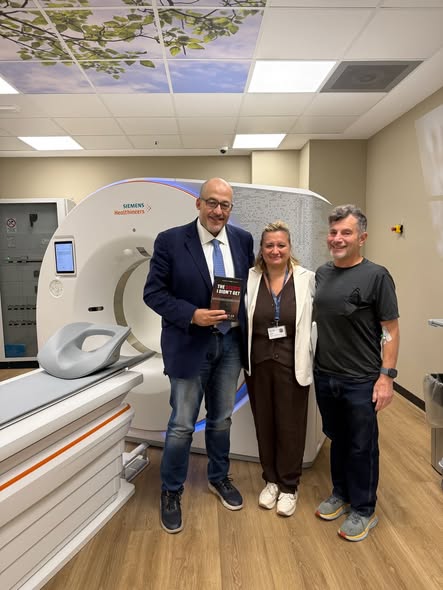
Wendy and I came to Milan so I could undergo a photon-counting CT scan, or PCCT, at Centro Diagnostico Italiano. This newer generation of CT technology produces exceptionally detailed images of coronary arteries, including plaque and the space available for blood flow. It can also reduce the distortion from calcium that sometimes makes blockages appear worse than they actually are.
For those of us trying to understand what’s happening inside our arteries, that’s a significant advance.
But the scanner is only part of the equation. The expertise of the person choosing the scanning protocol and interpreting the images matters enormously. That’s why I wanted Dr. Cademartiri, a pioneer in advanced cardiovascular imaging, to do mine.
Over dinner at a small local restaurant, he told us about his early experience in cardiac surgery and why he chose to pursue imaging. He believed that seeing disease earlier and more clearly could help doctors intervene preventively, reducing the need for operations such as bypass surgery.
Our dinner lasted three hours. I had a lot of questions.
One of them brought us to Tim, the husband of my daughter’s good friend.
An exceptionally fit athlete, Tim developed chest pain during a ride and went to the hospital to get thoroughly checked out. After his evaluation, he was cleared to resume riding.
What I hadn’t fully understood was the significance of another detail: his troponin had risen during that hospital visit.
Troponin is a protein released into the blood when heart muscle is injured.
I had always imagined that Tim’s fatal ride pushed his heart beyond what a severely narrowed artery could supply. Dr. Cademartiri suggested a different possibility: a plaque might already have ruptured during that first episode, triggering clotting and a small heart attack.
The fatal event six weeks later could have been connected to that same unstable plaque process.
He was offering an interpretation of the story I shared, without reviewing Tim’s medical records. Elevated troponin alone cannot establish exactly what happened. But his explanation changed how I understood those six weeks.
The first episode may already have been a heart attack—not just a warning that one could happen later.
That’s a distinction I suspect many of us in these groups can appreciate. Being fit, performing well, and getting reassuring test results are things we understandably want to take comfort in. But we also want to know what those results actually tell us about the disease in our artery walls.
I came to Milan hoping to get a clearer picture of my own arteries. Before I even stepped into the scanner, I was reconsidering the story that opens my book.
Next: the scan itself—and what Dr. Cademartiri could see.
heartCEO.ai is for informational and educational purposes only and does not provide medical advice, diagnosis, or treatment. Always consult a qualified physician about your health and before making any medical decision. Seek urgent care for acute symptoms.
More from The Story Continues.
heartCEO.ai is for informational and educational purposes only and does not provide medical advice, diagnosis, or treatment. Always consult a qualified physician about your health and before making any medical decision. Seek urgent care for acute symptoms.